
Thursday, 8 October 2026
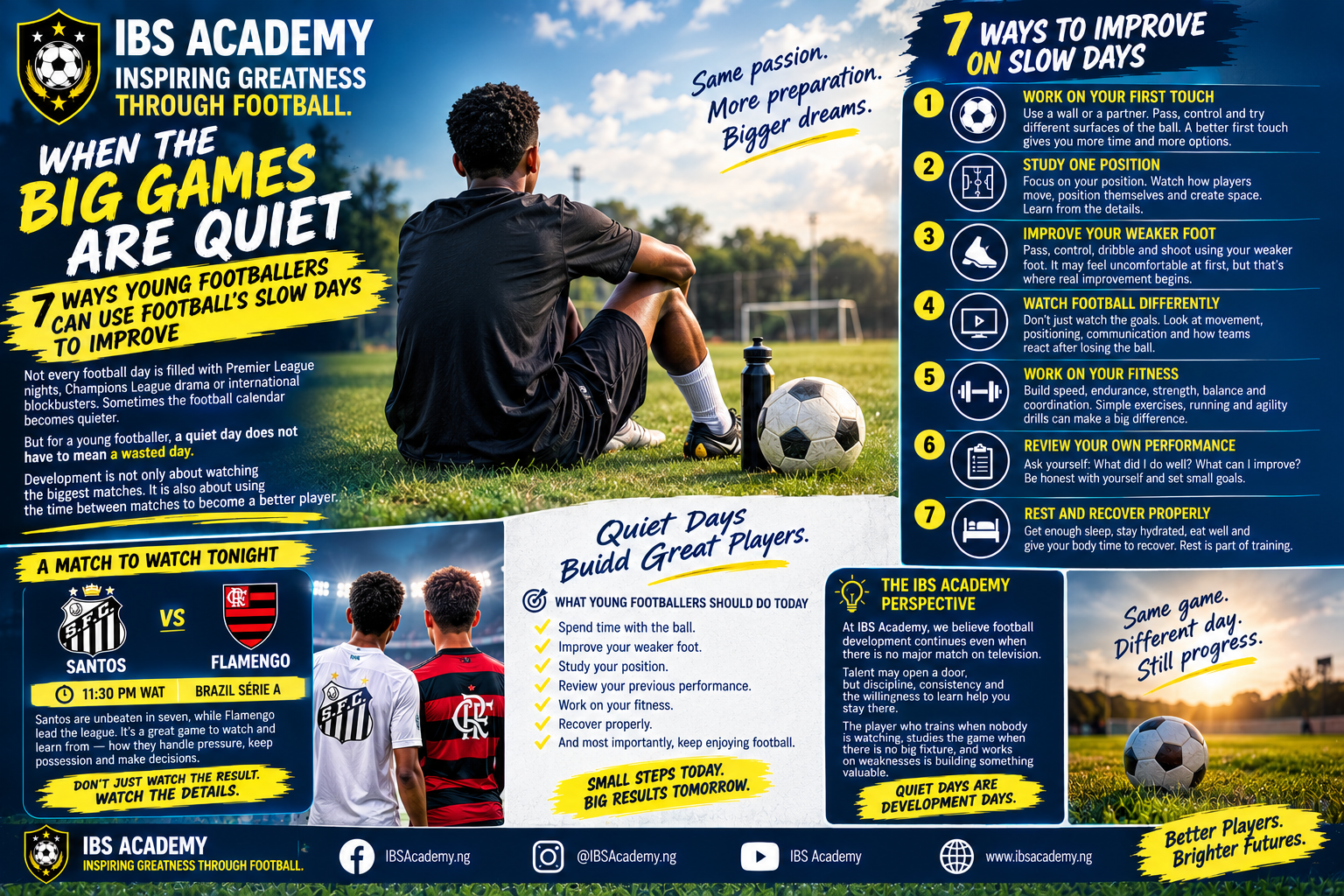
Not every football day is filled with Premier League nights, Champions League drama or international blockbusters.
Sometimes the football calendar becomes quieter.
But for a young footballer, a quiet football day does not have to mean a wasted day.
In fact, some of the best opportunities for improvement happen when there is less football to watch.
Today provides a perfect reminder that development is not only about watching the biggest matches. It is also about using the time between matches to become a better player.
One of today's notable fixtures is Santos vs Flamengo in the Brazilian Série A, with the match scheduled for 11:30 PM WAT. Santos come into the game on a seven-match unbeaten run, while Flamengo are leading the Brazilian championship.
But beyond tonight's football, what should young players actually be doing?
1. WORK ON YOUR FIRST TOUCH
You do not need a professional match to improve your first touch.
Find a wall.
Pass the ball against it.
Control it with your right foot.
Then your left.
Use the inside of your foot, outside of your foot and different surfaces of the ball.
A better first touch gives you more time and more options during matches.
2. STUDY ONE POSITION
Instead of trying to watch everything, choose one position.
Are you a midfielder?
Study midfielders.
Are you a defender?
Study defenders.
Are you an attacker?
Study attackers.
Look at where they position themselves before receiving the ball.
Look at when they move.
Look at how they create space.
Football becomes easier to understand when you learn to see the game from your position.
3. IMPROVE YOUR WEAKER FOOT
Many young players naturally prefer one foot.
That is normal.
But becoming comfortable with both feet can give you a major advantage.
Spend part of your training session using only your weaker foot.
Pass.
Control.
Dribble.
Shoot.
It may feel uncomfortable at first, but improvement usually begins with discomfort.
4. WATCH FOOTBALL DIFFERENTLY
When you do watch a match, don't watch only for goals.
Watch the players away from the ball.
Watch the defenders communicating.
Watch midfielders scanning.
Watch attackers creating space.
Watch how quickly teams react after losing possession.
The more details you notice, the more football knowledge you develop.
5. WORK ON YOUR FITNESS
Football requires more than technical ability.
Speed, endurance, balance, strength and coordination all matter.
A young player does not need complicated training to begin improving.
Running, bodyweight exercises, agility drills and football-specific movements can all become part of a structured training routine.
The key is consistency.
6. REVIEW YOUR OWN PERFORMANCE
One of the most powerful development tools is learning from yourself.
After training or a match, ask:
What did I do well?
What did I struggle with?
Did I make good decisions?
Was my first touch good enough?
Did I communicate with my teammates?
What can I improve before the next session?
Players who ask themselves these questions are more likely to keep developing.
7. REST AND RECOVER PROPERLY
Improvement does not happen only when you are training.
Your body also needs time to recover.
Get enough sleep.
Stay hydrated.
Eat properly.
Give tired muscles time to recover.
A young footballer who trains hard but never recovers properly can eventually struggle with fatigue and performance.
Rest is part of training.
A MATCH TO WATCH TONIGHT
SANTOS VS FLAMENGO — 11:30 PM WAT
For those staying up for some late-night football, Santos vs Flamengo is one of today's notable fixtures.
Santos are enjoying a strong run of form, while Flamengo arrive as the league leaders.
The match offers young footballers another opportunity to study how teams approach pressure, possession, transitions and decision-making when the stakes are high.
But remember:
Don't just watch the result. Watch the details.
WHAT YOUNG FOOTBALLERS SHOULD DO TODAY
A quiet football calendar can become a productive development day.
Spend time with the ball.
Improve your weaker foot.
Study your position.
Review your previous performance.
Work on your fitness.
Recover properly.
And most importantly, keep enjoying football.
THE IBS ACADEMY PERSPECTIVE
At IBS Academy, we believe football development continues even when there is no major match on television.
A footballer's growth is built through daily habits.
The player who trains when nobody is watching, studies the game when there is no big fixture, and works on weaknesses instead of only celebrating strengths is building something valuable.
Talent may open a door.
But discipline, consistency and the willingness to learn help you stay there.
THURSDAY'S FOOTBALL LESSON
QUIET DAYS ARE DEVELOPMENT DAYS.
You don't need a big match to become a better footballer.
Sometimes, you simply need a ball, a little space and the discipline to work.
CONCLUSION
Football will always have its big nights.
There will be Champions League evenings, major finals, international tournaments and unforgettable matches.
But between those moments are the ordinary days.
Those ordinary days are where players build extraordinary habits.
So if today's football calendar feels quiet, don't waste the opportunity.
Train.
Study.
Recover.
Reflect.
Improve.
Then return tomorrow as a better footballer than you were today.
IBS Academy – Inspiring Greatness Through Football.